|
|

|
Boginfo |
|
| |
|
|
|
|
Museum Tusculanums Forlag bruger cookies for at huske dine indstillinger. Ved at bruge sitet accepterer du dette. Accepter cookies
|
| |
 Nyhedsbrev Nyhedsbrev
 Print siden Print siden
|
|

|
0
|
Vejl. pris75 DKK 11 $ 10 € 9 £
|
|
Onlinepris60 DKK 9 $ 8 € 7 £
|
|
|
Må du bare eje denne bog?
Man kan desværre ikke købe direkte i vores webshop lige nu da den betalingsløsning vi tidligere har anvendt, er lukket; en ny og bedre hjemmeside er under udvikling.
Indtil videre kan man bestille bøger på den gammeldags maner, ved at skrive til order@mtp.dk.
Husk i bestillingen at angive modtagerens navn, forsendelsesadresse og mobilnummer (samt mailadresse hvis modtageren er en anden end dig selv).
Bestillinger sendes med PostNord, som udgangspunkt som pakker til afhentning i pakkeshop eller pakkeboks/nærboks; læs mere her. Hvis du behøver levering til døren eller ikke har mulighed for at hente fra pakkeboks/nærboks, så angiv også det i din bestilling.
|
 Se udvalgte sider Se udvalgte sider
Indholdsfortegnelse
▼ Din mening
▼ Kunder, som har købt denne titel, købte også
Fås også som e-tidsskrift
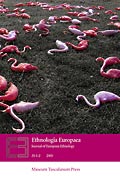
What is Europe? Where is Europe? And what is
Europe in the discipline of European ethnology?
This issue of Ethnologia Europaea celebrates the
journal’s 40th birthday by looking at future paths
for research on Europe.
For a long time the disciplines grouped under
the label of European ethnology were mainly
national ethnologies. The need for European comparisons
lived more in the Sunday rhetoric of the
discipline than in actual research, but with a new
interest in transnational processes the perspectives
have widened. The processes of economic unification
also gave rise to research on facets of a European
culture, conditioned, for instance, by the
administrative implementation of European
economic and, increasingly, cultural policies.
Local, regional and national cultural dimensions
do not vanish in this development, of course,
and neither do borders and boundaries, physical
and mental. Processes of EU integration as well as
globalization may both weaken and strengthen
national and regional borders, as we have seen
during the last decades, but such developments
call for a rethinking of Europe as a research field
and also a questioning of ideas about Europe or
European cultural homogeneity. The EU rhetoric
about unity hides a more complex picture, where
European integration and disintegration emerges
in often surprising settings and forms.
|
|
|
Indlæg offentliggøres med navn og e-mail. Forlaget forbeholder sig ret til at redigere og udelade indlæg.Kunder, som har købt denne titel, købte også
|
|
|
|
|
|
|
|
|
|
|