|
|

|
Boginfo |
|
| |
|
|
|
|
Museum Tusculanums Forlag bruger cookies for at huske dine indstillinger. Ved at bruge sitet accepterer du dette. Accepter cookies
|
| |
 Nyhedsbrev Nyhedsbrev
 Print siden Print siden
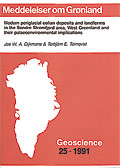
Dijkmans, Jos W. A. & Torbjörn E. Törnqvist
Modern periglacial eolian deposits and landforms in the Søndre Strømfjord area, West Greenland and their palaeoenvironmental implications
1991, 39 sider
Illustreret
19 x 26,5 cm
ISBN 978-87-635-1209-1
Serie:
Monographs on Greenland | Meddelelser om Grønland, vol. 281
ISSN 0025-6676
Serie:
Geoscience, vol. 25
ISSN 0106-1046
|
|
|
Vejl. pris75 DKK 11 $ 10 € 9 £
|
|
Onlinepris60 DKK 9 $ 8 € 7 £
|
|
|
Må du bare eje denne bog?
Man kan desværre ikke købe direkte i vores webshop lige nu da den betalingsløsning vi tidligere har anvendt, er lukket; en ny og bedre hjemmeside er under udvikling.
Indtil videre kan man bestille bøger på den gammeldags maner, ved at skrive til order@mtp.dk.
Husk i bestillingen at angive modtagerens navn, forsendelsesadresse og mobilnummer (samt mailadresse hvis modtageren er en anden end dig selv).
Bestillinger sendes med PostNord, som udgangspunkt som pakker til afhentning i pakkeshop eller pakkeboks/nærboks; læs mere her. Hvis du behøver levering til døren eller ikke har mulighed for at hente fra pakkeboks/nærboks, så angiv også det i din bestilling.
|
▼ Din mening
▼ Kunder, som har købt denne titel, købte også
Modern fluvoglacial sediments in two east-west oriented valley between Søndre Strømfjord Air Base and the Inland Ice (West Greenland) are partly redeposited by eolian activity. Topographic barriers have induced an areal distinction between sandy and silty eolian sediments. morpholgical and sedimentological investigations enable a facies analysis of these rare, active cold-climate eolian deposits and a comparison with the extensive Pleistocene sand sheets and loess deposits of Europe.
Eolian processes are active throughout the year in a dry cold-climate environment. Accumulation of eolian material on the eolian sand sheets and silt covers mainly takes place in summer, whereas deflation and redeposition is dominant in winter. Meteorological conditions (especially thickness of snow cover) may prevent eolian activity.
The vegetation on the sand sheets adapts itself to the intensity of the eolian activity. Vegetation is scarce in the low areas near the active flood plains where deflation is intensive, whereas the downwind depositional areas are more densely vegetated. Only a few species play an active role in the formation of small phytogenic dunes, which are characterized by a low percentage potential. Similar conditions are envisaged for the extensive Pleistocene sand seas of northwestern Europe.
A characteristic sedimentary sequence occurs in downwind, upslope direction. Fluvio-eolian deposits on and near the active flood plain are characterized by horizontally bedded eolian sand interbedded with fluvial deposits. The latter are partly winnowed by eolian activity leading to inversely graded lamination. horizontal bedding of fine-medium grained sand sheets. Within-bed structures re dominated by planebed lamination. A more homogeneous (fine-medium grained) horizontally bedded sediment, comparable to that dominating in the extensive Pleistocene sand sheets, represents the distal facies of these sand sheets.
The uplands are covered by eolian silt deposits. These are coarser than "typical" loess and lack other loess characteristics. This is explained by the local source area and the short transport distance. These "proximal loess" deposits are mainly deposited on the windward side of the valley walls due to blocking of dust-laden airflows by these topographic barriers. The primary micro-lamination in these deposits may also have been present in the Pleistocene loess deposits.
Indlæg offentliggøres med navn og e-mail. Forlaget forbeholder sig ret til at redigere og udelade indlæg.Kunder, som har købt denne titel, købte også
|
|
|
|
|
|
|
|
|
|
|